In today’s digital world, a business’s online reputation can directly influence customer trust and purchasing decisions. Before choosing a restaurant, clinic, salon, or service provider, customers often check online reviews, ratings, and social media comments. A single negative review or an unanswered complaint can affect how potential customers perceive a business.
Monitoring every review and brand mention manually is difficult, especially when customers interact with businesses across multiple platforms. This is where AI-powered online reputation monitoring helps businesses track customer feedback, identify potential problems, and respond more efficiently.
With AI, businesses can monitor their online reputation around the clock instead of waiting for someone to check reviews manually.
What Is AI-Powered Online Reputation Monitoring?
AI-powered reputation monitoring uses artificial intelligence to collect and analyze available online feedback, identify sentiment, detect recurring issues, and notify businesses about important changes.
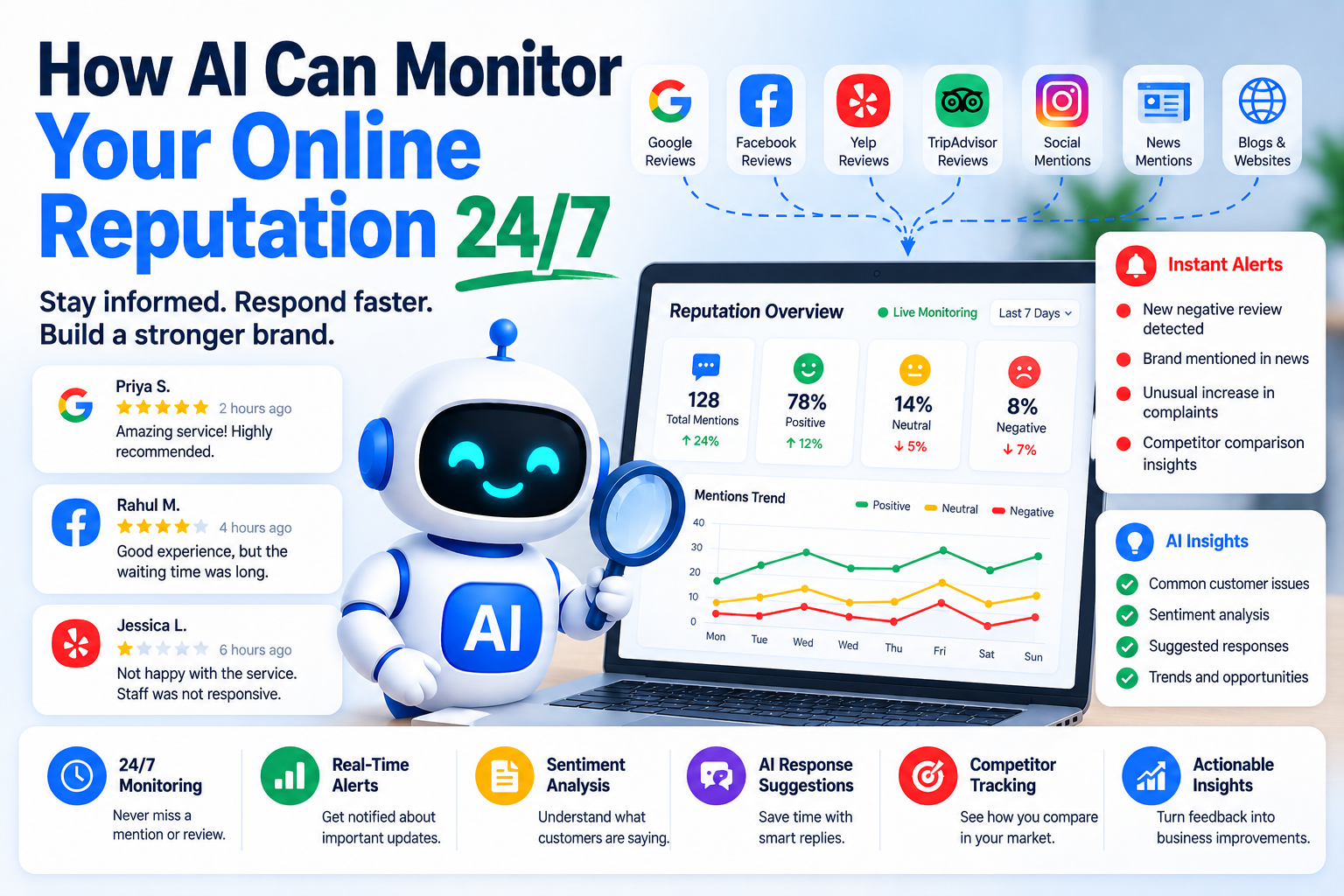
Depending on the tools and integrations used, businesses can monitor information from sources such as:
- Google reviews
- Facebook reviews and comments
- Yelp and TripAdvisor
- Social media mentions
- Online forums
- News websites and blogs
- Industry-specific review platforms
Not every tool supports every platform, so businesses should confirm which sources are available before choosing a solution.
Unlike basic review alerts, AI can help explain what customers are saying and identify patterns across large volumes of feedback.
Why Monitoring Your Online Reputation Matters
Customers increasingly rely on online information when deciding which business to trust. A strong reputation can encourage inquiries, bookings, and purchases, while unresolved complaints may discourage potential customers.
Regular reputation monitoring helps businesses:
- Identify customer complaints quickly
- Respond to reviews more consistently
- Understand customer expectations
- Discover recurring service problems
- Protect brand credibility
- Identify opportunities to improve customer experience
The goal is not simply to maintain a high rating. It is to understand customer feedback and use it to improve the business.
How AI Monitors Your Reputation 24/7
1. Tracks New Reviews and Brand Mentions
AI-powered tools can monitor connected platforms for new reviews and relevant brand mentions.
When a new review or mention is detected, the system can record details such as the platform, date, rating, and feedback.
For example, a restaurant might receive a new review mentioning slow service during busy hours. An automated monitoring system can flag the review so management can investigate without waiting for a weekly manual check.
Continuous monitoring depends on the availability and frequency of data updates from each platform.
2. Detects Negative Sentiment
Not all negative feedback includes a low star rating. Customers may express dissatisfaction through comments, posts, or detailed descriptions of their experiences.
AI sentiment analysis helps classify feedback as positive, neutral, or negative.
For example:
- Positive: “The staff were friendly and the service was excellent.”
- Neutral: “The appointment was moved to the afternoon.”
- Negative: “I waited 40 minutes despite having a confirmed appointment.”
AI can highlight negative feedback for review, helping businesses prioritize issues that may require attention.
Sentiment analysis is not perfect, particularly when comments contain sarcasm, slang, or ambiguous language. Important findings should be verified before action is taken.
3. Sends Instant Alerts for Important Issues
Some feedback deserves faster attention than other comments.
AI monitoring systems can be configured to flag situations such as:
- A sudden increase in negative reviews
- Multiple complaints about the same issue
- Serious customer service concerns
- Unusual changes in review activity
- Negative mentions on important platforms
Alerts can be delivered through supported channels such as email, messaging applications, or internal dashboards.
This allows the right team member to investigate the issue before it escalates.
4. Identifies Recurring Customer Complaints
Reading individual reviews may not reveal a larger operational problem. AI can analyze multiple reviews and group similar comments into common themes.
For example, a service business may discover that customers repeatedly mention:
- Delayed appointments
- Difficulty reaching support
- Confusing pricing
- Inconsistent service quality
These patterns can help management identify problems that require operational changes.
Instead of treating every complaint separately, businesses can address the underlying cause.
5. Tracks Customer Sentiment Over Time
A single review provides limited information about overall customer satisfaction. Changes over several weeks or months can reveal more meaningful patterns.
AI can compare sentiment across different periods and highlight changes in customer feedback.
For example, if negative comments about delivery delays increase after a change in operations, the business can investigate whether the new process is contributing to the problem.
Tracking sentiment over time helps businesses measure whether their improvements are making a difference.
AI Can Help Businesses Respond to Reviews Faster
Responding to reviews shows customers that their feedback is being taken seriously.
AI can draft personalized responses based on the review’s content and tone.
For positive reviews, it can suggest a friendly thank-you message. For negative reviews, it can prepare a professional response that acknowledges the concern and offers an appropriate next step.
However, responses should not be published blindly.
Businesses should verify the facts, avoid sharing private customer information, and review sensitive complaints before replying. Automated responses should also comply with each platform’s policies.
Competitor Reputation Monitoring
Online reputation monitoring can also provide insights into competitors.
Businesses may be able to analyze publicly available reviews and mentions to understand:
- What customers appreciate about competitors
- Which complaints appear repeatedly
- What services customers value most
- How customer expectations are changing
- Where competitors may be falling short
For example, if customers frequently praise a competitor’s convenient booking process, another business could evaluate whether its own booking experience needs improvement.
Competitor monitoring should focus on learning from publicly available information rather than copying reviews or making unsupported claims.
Turning Customer Feedback Into Business Improvements
One of the most valuable benefits of AI is its ability to transform unstructured feedback into actionable insights.
Consider a clinic that receives dozens of reviews each month. Manually identifying recurring themes can be time-consuming.
An AI-generated report might reveal that patients appreciate the doctor’s expertise but frequently mention long waiting times.
Management can then investigate appointment scheduling, staffing, or patient communication.
The same approach can help restaurants improve service, retailers address product issues, and service providers refine their customer experience.
The real value of AI monitoring is not just knowing what customers say. It is understanding what the business should do next.
Important Reputation Metrics to Track
Businesses can use a weekly or monthly dashboard to monitor key indicators.
| Metric | What It Helps You Understand |
|---|---|
| Average rating | Overall review rating trends |
| New reviews | Changes in feedback volume |
| Negative review count | Potential customer experience issues |
| Sentiment trends | Shifts in customer perception |
| Response time | How quickly feedback is addressed |
| Unanswered reviews | Feedback requiring a response |
| Recurring complaint themes | Operational issues to investigate |
| Brand mention volume | Changes in online discussion |
These metrics should be interpreted together. A rising number of negative reviews, for example, is more meaningful when examined alongside total review volume and the issues customers describe.
Which Businesses Benefit Most From AI Reputation Monitoring?
AI-powered reputation monitoring can benefit almost any business that receives online feedback, including:
- Medical clinics: Monitor patient feedback and identify recurring concerns.
- Restaurants and cafes: Track comments about food, service, and waiting times.
- Salons and spas: Understand customer satisfaction with appointments and treatments.
- Hotels: Identify recurring complaints about facilities and guest experiences.
- Real estate agencies: Monitor feedback about communication and service.
- Automotive workshops: Identify concerns about repair quality, pricing, and turnaround times.
- Retail businesses: Track product feedback and customer service issues.
Businesses with multiple locations may benefit even more because AI can help compare feedback across branches and identify location-specific problems.
How to Build an AI Reputation Monitoring Workflow
A practical automated workflow can follow these steps:
- Collect: Retrieve new reviews and brand mentions from connected sources.
- Analyze: Classify sentiment and identify the main topics.
- Prioritize: Flag urgent complaints or unusual changes.
- Notify: Send alerts to the appropriate team member.
- Respond: Draft a suitable response for human review.
- Report: Summarize review trends and recurring themes.
- Improve: Use the findings to address customer concerns.
This process reduces repetitive manual work while keeping important decisions under human control.
Best Practices for AI Reputation Management
To get the most from AI-powered monitoring:
- Connect only platforms supported by your chosen tools.
- Keep business information and monitoring rules updated.
- Set clear criteria for urgent alerts.
- Review AI sentiment classifications for accuracy.
- Personalize responses rather than relying on generic templates.
- Protect customer information and follow applicable privacy requirements.
- Never purchase fake reviews or manipulate customer feedback.
- Use complaints as opportunities to improve service.
AI works best when it supports a genuine commitment to customer satisfaction.
The Future of Online Reputation Management
Online reputation management is moving beyond manually checking star ratings and responding to individual reviews. AI enables businesses to identify patterns, detect changes, and organize feedback from multiple sources more efficiently.
As monitoring tools become more capable, businesses can use reputation data to improve customer service, strengthen communication, and make better operational decisions.
However, automation should complement human judgment. Serious complaints, sensitive issues, and important public responses still require careful review.
Final Thoughts
AI is changing how businesses manage their online reputation by making customer feedback easier to monitor, analyze, and act upon. From detecting negative reviews to identifying recurring complaints and generating actionable reports, AI helps businesses stay informed without constantly checking every platform manually.
For local businesses, the best approach is to combine continuous monitoring with timely responses and meaningful service improvements. When customer feedback is treated as a source of insight rather than just a rating to manage, AI becomes a valuable tool for building trust and maintaining a stronger online reputation.