Customer reviews are one of the most valuable sources of information for a local business. They reveal what customers appreciate, where they experience problems, and how the business is perceived compared with competitors.
The challenge is that reviews can arrive across multiple platforms, making it difficult for business owners to monitor everything manually.
This is where AI review monitoring can help.
Instead of checking every review individually, AI can analyze new feedback, identify recurring themes, detect changes in customer sentiment, and highlight reviews that require immediate attention.
For a local business, a weekly review-monitoring system can turn customer feedback into actionable insights rather than letting valuable information get buried in review notifications.
Why Weekly Review Monitoring Matters
A review from three months ago may still be useful, but a new review can reveal an issue that needs attention immediately.
For example, several recent customers might mention:
- Long waiting times
- Difficulty booking appointments
- Poor communication
- Staff friendliness
- Product quality
- Pricing concerns
When these patterns are identified early, businesses have an opportunity to investigate and improve the underlying customer experience.
Weekly monitoring creates a regular feedback loop:
New reviews → AI analysis → Identify patterns → Take action → Monitor changes
What Should a Business Track Every Week?
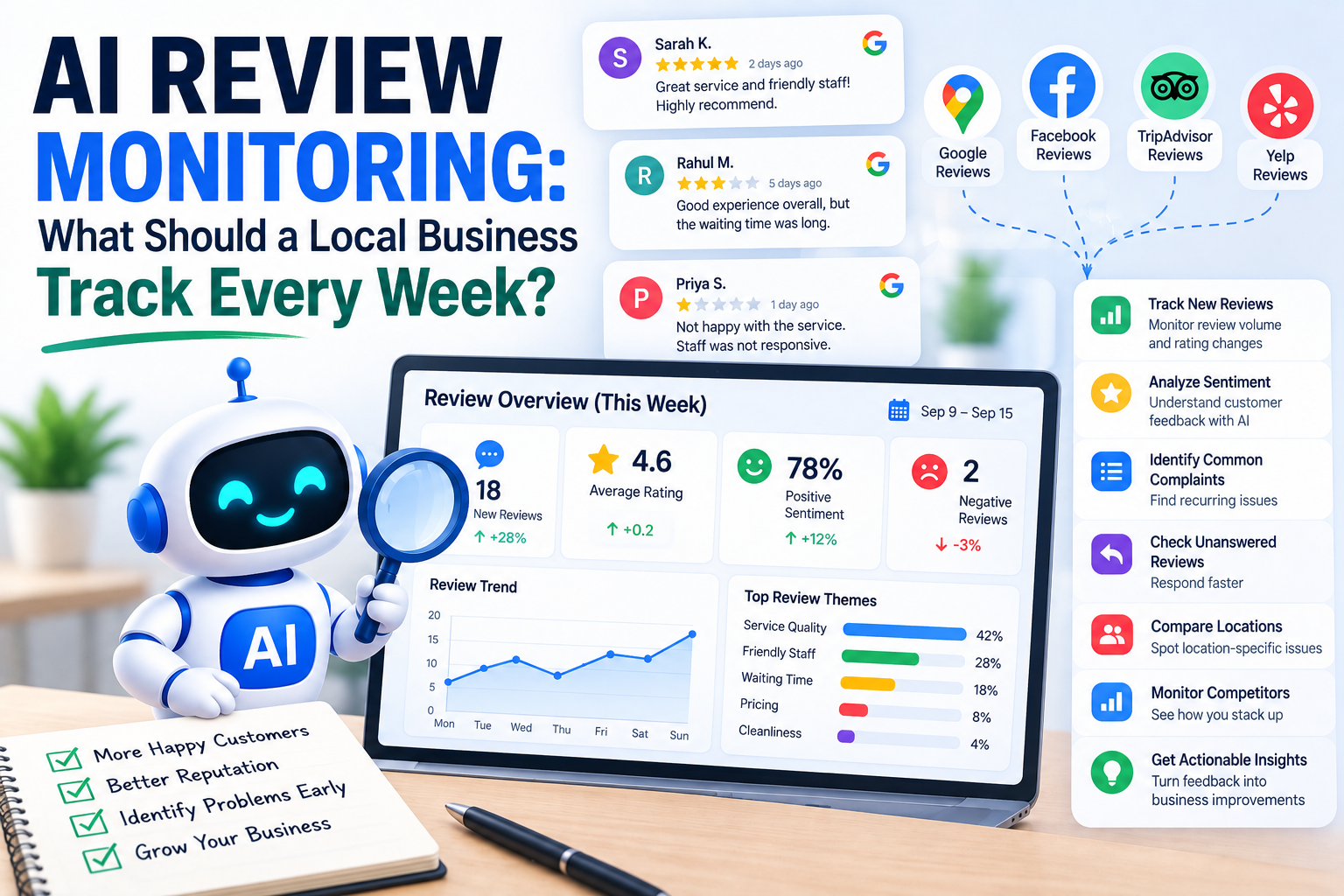
Not every review metric needs to be complicated. A useful weekly dashboard can focus on a few important areas.
1. New Reviews
The first metric is simple: How many new reviews did the business receive?
Track:
- Total new reviews
- Reviews by platform
- Reviews by location
- Positive reviews
- Neutral reviews
- Negative reviews
A sudden change in review volume can be worth investigating.
For example, if a business normally receives 15 reviews per week but suddenly receives only two, the business may want to check whether customer engagement, review requests, or another operational factor has changed.
2. Average Rating
Track changes in the overall rating over time.
Rather than looking only at the current star rating, compare it with previous periods.
For example:
Previous month: 4.6
Current month: 4.4
The change itself is worth investigating, particularly if it coincides with an increase in negative feedback.
The goal isn’t simply to chase a higher rating. The more useful question is:
What is causing customers to rate the business differently?
3. New Negative Reviews
Negative reviews deserve attention, but not every negative review represents the same problem.
AI can categorize negative feedback into topics such as:
- Service delays
- Staff behavior
- Product problems
- Pricing
- Communication
- Cleanliness
- Appointment issues
- Delivery problems
This makes it easier to identify operational problems rather than treating every negative review as an isolated incident.
4. Review Sentiment
AI can analyze the overall sentiment of recent reviews.
A weekly sentiment report might show:
Positive: 78%
Neutral: 14%
Negative: 8%
More importantly, AI can compare sentiment over time.
For example:
Customer sentiment has declined over the last three weeks, with several recent reviews mentioning longer waiting times.
This gives business owners an early warning before a small problem becomes a recurring complaint.
5. Recurring Customer Complaints
One of the most useful AI capabilities is theme detection.
Instead of reading 100 reviews individually, AI can identify repeated topics.
For example:
Most common positive themes
- Friendly staff
- Fast service
- Product quality
Most common negative themes
- Waiting time
- Parking
- Appointment delays
This provides a much clearer picture of customer experience.
6. Frequently Praised Services
AI should not only look for problems.
It can identify the services, products, or experiences customers mention positively.
For example:
“Customers frequently praise your same-day repair service and staff communication.”
This information can help businesses understand what they should emphasize in:
- Website content
- Marketing campaigns
- Google Business Profile posts
- Social media
- Advertising
Customer reviews can therefore become a source of marketing insights.
7. Unanswered Reviews
Businesses should track whether new reviews have received responses.
A weekly report can highlight:
- Unanswered positive reviews
- Unanswered neutral reviews
- Unanswered negative reviews
- Reviews requiring management attention
AI can draft responses, but businesses should review them before publishing, especially when the review involves a complaint or sensitive situation.
8. Response Time
Another useful metric is how quickly the business responds to reviews.
For example:
Average response time: 2.5 days
A business can then establish an internal goal for responding more consistently.
Fast responses aren’t simply about appearing active. They also give businesses an opportunity to address customer concerns while the interaction is still recent.
9. Review Themes by Location
Multi-location businesses have an additional challenge.
One branch may receive excellent feedback about service while another repeatedly receives complaints about waiting times.
AI can separate review data by location.
For example:
| Location | Rating | Main Positive Theme | Main Complaint |
|---|---|---|---|
| Location A | 4.7 | Staff | Parking |
| Location B | 4.5 | Service quality | Waiting time |
| Location C | 4.2 | Product quality | Communication |
This allows management teams to identify location-specific problems instead of treating all branches the same.
10. Competitor Review Trends
Businesses can also monitor publicly available competitor reviews.
AI can identify themes customers frequently mention about competing businesses.
For example:
Competitors frequently praised for:
- Fast appointments
- Friendly staff
- Easy booking
Your customers frequently praise:
- Product quality
- Personalized service
These insights can help businesses understand what customers value within their local market.
The purpose is not to copy competitors but to identify opportunities for differentiation and improvement.
11. Review Keywords and Customer Language
Customers often use language that businesses wouldn’t think to include in their marketing.
For example, a customer may describe a service as:
“Quick, painless, and easy to book.”
These phrases can reveal how real customers describe the business.
AI can collect frequently used terms and help identify language that may be useful for:
- Website copy
- FAQs
- Service pages
- Social media content
- Google Business Profile posts
Customer language can make marketing communication more natural and relevant.
12. Sudden Changes in Review Patterns
AI monitoring becomes especially useful when it can detect unusual changes.
For example:
- A sudden increase in negative reviews
- A sharp drop in review volume
- Multiple reviews mentioning the same issue
- A sudden change in sentiment
- A new recurring complaint
Instead of waiting for the monthly report, businesses can receive an alert when something unusual happens.
A Simple Weekly AI Review Dashboard
A local business doesn’t need hundreds of metrics.
A practical weekly dashboard could include:
| Metric | This Week | Previous Week | Status |
|---|---|---|---|
| New Reviews | 18 | 14 | Increased |
| Average Rating | 4.6 | 4.6 | Stable |
| Negative Reviews | 2 | 1 | Monitor |
| Unanswered Reviews | 3 | 5 | Improving |
| Positive Sentiment | 81% | 84% | Monitor |
| Top Complaint | Waiting time | Parking | Changed |
| Top Positive Theme | Staff | Staff | Consistent |
AI can then summarize the data into a short management report.
Example AI Summary
Weekly Review Summary:
Review volume increased this week, while the average rating remained stable. Customers continue to praise staff friendliness. However, waiting time appeared in several recent reviews and should be investigated. Three new reviews still require responses.
This is much easier for a business owner to act on than reading dozens of individual reviews.
What AI Should Do vs What Humans Should Do
AI is excellent at processing large amounts of feedback quickly, but human judgment remains important.
AI Can:
- Collect review data
- Categorize reviews
- Analyze sentiment
- Identify recurring themes
- Detect unusual changes
- Draft responses
- Create weekly summaries
- Compare trends over time
Humans Should:
- Investigate serious complaints
- Verify factual claims
- Decide how operational problems should be fixed
- Handle sensitive customer situations
- Approve important responses
- Make business decisions based on the feedback
The best system combines automated analysis with human decision-making.
How AI Review Monitoring Supports Local SEO
Reviews are also relevant to local search visibility and customer trust.
Google says businesses can interact with customers through their Business Profiles by responding to reviews, and businesses should follow its policies when managing their profiles.
However, review monitoring should not become a process of simply trying to manipulate ratings.
The objective should be to:
- Understand customers
- Respond appropriately
- Improve service
- Maintain accurate business information
- Build genuine customer trust
Better customer experiences naturally create opportunities for better feedback.
A Weekly Review Monitoring Workflow
A simple AI-powered workflow could look like this:
Monday:
Collect new reviews from relevant platforms.
Tuesday:
Analyze sentiment and categorize feedback.
Wednesday:
Identify recurring complaints and positive themes.
Thursday:
Flag unanswered or high-priority reviews.
Friday:
Generate a weekly summary and action list.
This can be automated so business owners receive a concise report without manually checking every platform.
Final Thoughts
AI review monitoring is more than an automated system for finding negative reviews. When used correctly, it becomes a customer intelligence tool.
Every week, local businesses should track review volume, rating changes, sentiment, recurring complaints, positive themes, unanswered reviews, response times, customer language, and unusual changes in feedback.
The biggest advantage of AI is its ability to turn hundreds of individual customer comments into a few clear patterns that business owners can understand and act on.
For local businesses, the goal shouldn’t simply be to collect more reviews. It should be to listen to what customers are saying, identify what needs improvement, and use that information to create a better customer experience.