A Google Business Profile (GBP) is often the first thing potential customers see when they search for a local business. It can influence whether someone calls, visits a website, asks for directions, or chooses a competitor.
But keeping a GBP fully optimized is not a one-time task. Business information changes, reviews arrive, new services are added, competitors become more active, and profile performance can fluctuate.
The challenge is that manually checking every part of a Google Business Profile can take hours.
This is where AI-powered GBP auditing can make a major difference.
Instead of manually reviewing dozens of profile elements, AI can analyze business information, identify missing or inconsistent details, evaluate content activity, examine reviews and performance data, and turn the findings into a prioritized action plan.
What Is a Google Business Profile Audit?
A GBP audit is a structured review of the important elements that affect the quality, completeness, and usefulness of a business profile.
An audit can examine areas such as:
- Business information
- Primary and secondary categories
- Business description
- Services
- Attributes
- Business hours
- Website and contact information
- Photos and videos
- Google Posts
- Customer reviews
- Profile activity
- Performance data
- Local search visibility
Google itself recommends keeping Business Profile information complete and accurate and identifies relevance, distance, and prominence as the main factors behind local results.
Why Manual GBP Audits Take So Long
A business owner or SEO professional may need to check multiple sections of a profile individually.
They may also need to compare the profile against:
- The business website
- Other business directories
- Competitor profiles
- Customer reviews
- Search results
- Historical performance data
For businesses with multiple locations, the workload increases dramatically.
AI can reduce much of this repetitive analysis by bringing the information together and highlighting the areas that require attention.
How AI Audits a Google Business Profile
An AI-powered audit can follow a structured process.
Step 1: Collect Business Information
The first step is gathering the available profile data.
AI can analyze information such as:
- Business name
- Address
- Phone number
- Website
- Business category
- Hours
- Services
- Attributes
- Description
The goal is to determine whether important information is present, accurate, and consistent.
Google states that complete and accurate Business Profile information makes it easier for customers to understand what a business offers, where it is located, and when they can visit.
Step 2: Check Profile Completeness
AI can identify missing information that may otherwise be overlooked.
For example:
Business Profile
- Business name: Complete
- Category: Complete
- Phone: Complete
- Website: Complete
- Hours: Missing holiday hours
- Services: Incomplete
- Attributes: Several relevant attributes not configured
- Photos: Low activity
Instead of simply saying “your profile needs optimization,” an AI audit can provide a checklist of specific actions.
Step 3: Analyze Business Categories
Categories help Google understand what a business does and which searches may be relevant.
An AI audit can check whether:
- The primary category accurately represents the business
- Relevant secondary categories are being used
- Categories are consistent with the actual services
- The profile is using categories appropriately
However, AI should recommend changes rather than blindly modifying categories. Google specifically advises businesses not to use categories simply as keywords or to describe business features.
Step 4: Analyze Services and Attributes
Services and attributes provide additional information about what a business offers.
For example, a salon might list:
- Hair coloring
- Haircuts
- Bridal styling
- Hair treatments
Attributes might communicate details such as:
- Wi-Fi
- Accessibility
- Outdoor seating
- Payment options
Google notes that attributes can help customers understand specific features of a business and may help businesses appear in searches related to those attributes.
AI can identify missing or potentially relevant attributes and services for review.
Step 5: Review the Business Description
The business description should clearly explain what the business does and what makes it useful to customers.
AI can check for:
- Clear service information
- Location relevance
- Readability
- Unnecessary repetition
- Keyword stuffing
- Missing important business information
It can then suggest a cleaner version that is written for customers rather than simply inserting keywords.
Google allows businesses to use AI to help create their business description in some regions and languages, while the description itself has a 750-character limit.
Step 6: Analyze Google Business Profile Posts
AI can review recent posts and identify issues such as:
- Repetitive topics
- Inconsistent messaging
- Outdated promotions
- Lack of content variety
- Missing calls to action
- Low posting activity
Google Business Profile posts can be used to share updates, offers, and events with customers. Google also reviews posts for compliance with its content policies.
An AI audit can therefore answer questions such as:
Are we posting regularly?
Are we repeating the same message?
Are our posts actually useful to customers?
Step 7: Analyze Customer Reviews
Reviews contain valuable information about how customers perceive a business.
AI can analyze large numbers of reviews and identify:
- Frequently mentioned services
- Common complaints
- Positive customer experiences
- Recurring problems
- Sentiment patterns
- Unanswered reviews
- Opportunities for improvement
For example, an AI audit might discover:
“Customers frequently praise appointment availability but repeatedly mention delays during peak hours.”
That insight is more useful than simply knowing the business has a 4.6-star rating.
Google also recommends responding to reviews because replies show customers that the business values their feedback.
Step 8: Analyze Photos and Media
Visual content is another important part of a complete profile.
AI can help identify whether a profile contains a reasonable mix of:
- Exterior photos
- Interior photos
- Products
- Services
- Team members
- Work samples
- Facilities
It can also flag profiles that have very little recent media activity.
Google recommends adding photos and videos to help customers understand what a business offers.
Step 9: Analyze Performance Data
A GBP audit becomes much more useful when profile quality is compared with actual performance.
Google’s Business Profile performance reporting can show information about how customers discover and interact with a profile, including searches, views, and other customer actions.
AI can analyze this information to identify patterns such as:
- Increasing searches but declining website clicks
- High profile views but few calls
- Search terms unrelated to important services
- Changes in customer actions
- Locations or services generating stronger engagement
Instead of presenting a spreadsheet full of numbers, AI can summarize what the numbers mean and identify areas worth investigating.
Step 10: Compare the Business With Competitors
An advanced AI audit can also examine competing businesses.
It can compare publicly available information such as:
- Categories
- Services
- Reviews
- Ratings
- Photos
- Posting activity
- Website content
- Local search visibility
This helps identify potential gaps.
For example:
Competitor A: 25 service-related posts
Your profile: 4 posts
Potential opportunity: Build a more consistent service-focused content strategy.
The goal isn’t to copy competitors. It is to understand where your profile may be missing useful information.
AI Can Turn the Audit Into an Action Plan
One of the biggest advantages of AI is that it can prioritize recommendations.
Instead of receiving a long list of problems, a business could receive:
High Priority
- Update incorrect business hours
- Complete missing service information
- Respond to unanswered reviews
Medium Priority
- Add relevant profile attributes
- Improve business description
- Add new service photos
Ongoing
- Publish useful profile updates
- Monitor customer reviews
- Track performance changes
This makes the audit much easier to act on.
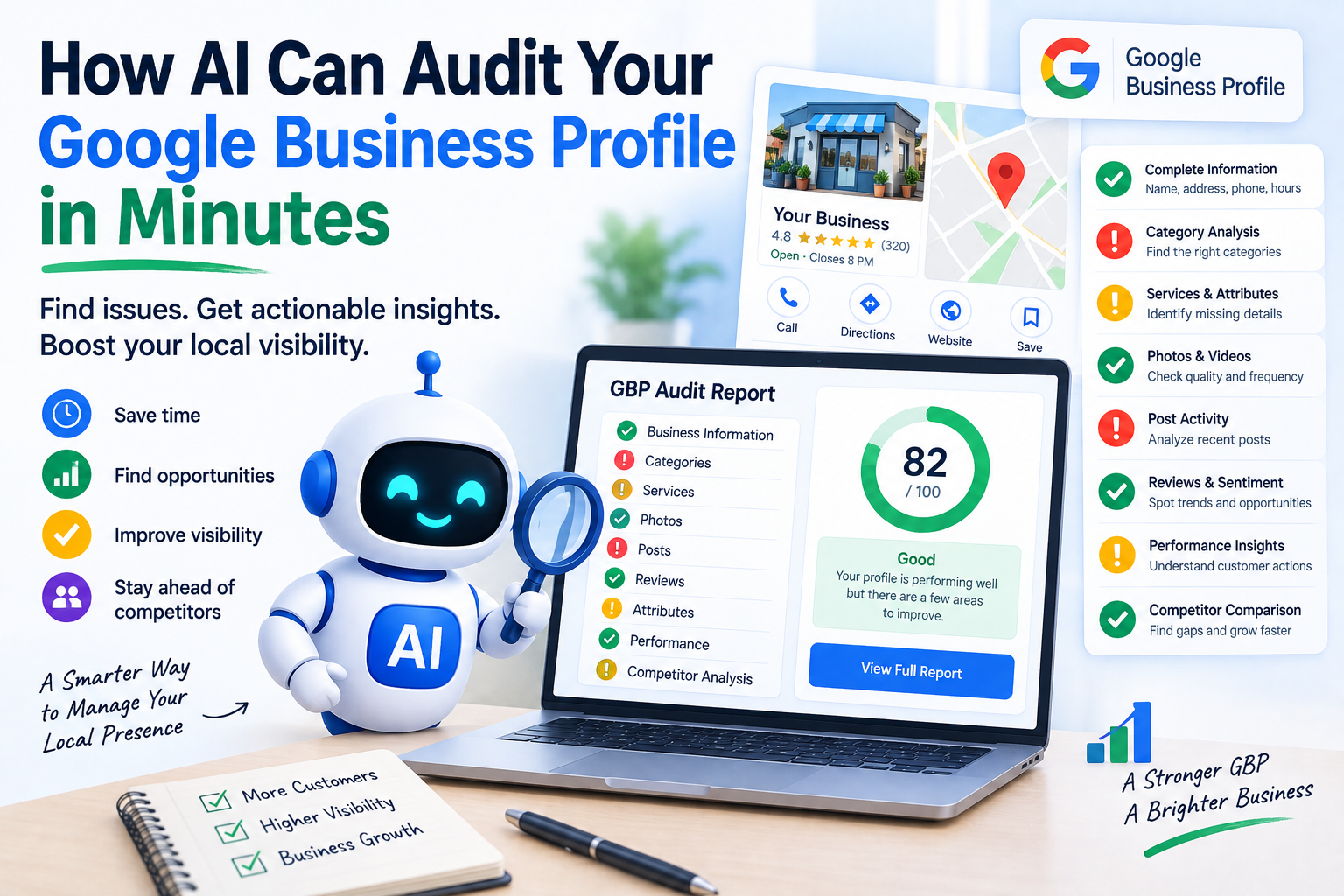
What an AI-Powered GBP Audit Report Could Look Like
A useful automated report could contain:
| Audit Area | Status | Finding | Recommended Action |
|---|---|---|---|
| Business Information | Good | Core information complete | Continue monitoring |
| Categories | Review | Secondary category opportunity | Verify relevant categories |
| Services | Needs Work | Several services missing | Add accurate services |
| Reviews | Attention | Unanswered reviews detected | Respond professionally |
| Posts | Needs Work | Low content activity | Create useful updates |
| Photos | Attention | Limited recent media | Add current photos |
| Performance | Monitor | Search activity changed | Investigate search trends |
This turns raw profile data into something a business owner can actually use.
AI Auditing Does Not Mean Automatic Changes
There is an important distinction between auditing and automatically changing a Business Profile.
AI should identify potential problems and recommend actions, while important changes should be reviewed before they are applied.
This is particularly important for:
- Business names
- Addresses
- Categories
- Services
- Hours
- Promotions
- Business descriptions
Google reviews Business Profile edits, and some changes can remain pending or be rejected if Google cannot confirm their accuracy.
Human verification therefore remains an important part of responsible automation.
How Often Should You Audit a GBP?
A Business Profile does not need to be manually rebuilt every week.
Instead, businesses can use different audit frequencies for different areas:
Weekly
- Reviews
- New profile activity
- Posts
- Important changes
Monthly
- Services
- Attributes
- Photos
- Competitor activity
- Performance trends
Quarterly
- Full profile audit
- Website alignment
- Category review
- Local SEO strategy
- Content opportunities
AI makes these recurring checks significantly easier to manage.
The Future of GBP Management Is Proactive
Traditional GBP management often involves fixing problems after they become noticeable.
AI enables a more proactive approach.
Instead of:
Problem → Manual discovery → Manual analysis → Fix
the process can become:
Continuous monitoring → AI detects issue → Priority alert → Human review → Action
This is especially valuable for agencies and businesses managing multiple locations.
Final Thoughts
A Google Business Profile contains far more information than a simple business listing. Keeping it accurate, complete, active, and useful requires ongoing attention.
AI-powered auditing can make this process dramatically faster by analyzing profile information, reviews, services, attributes, posts, media, performance data, and competitor signals in one workflow.
The real value of AI isn’t simply producing a higher “audit score.” It is turning a large amount of business data into clear, prioritized actions that a business owner or marketing team can actually implement.
As local search becomes increasingly competitive, automated GBP audits can help businesses move from occasional profile maintenance to continuous optimization—while keeping human review at the center of important decisions.