Digital marketing has become essential for businesses of every size. Whether you run a retail store, a restaurant, a service-based company, or an online business, having a strong digital presence helps you connect with potential customers, build brand awareness, and increase sales.
However, managing digital marketing isn’t always easy for small businesses. Creating content, managing social media accounts, responding to customers, running campaigns, and tracking performance can consume valuable time and resources.
This is where Artificial Intelligence (AI) is making a significant difference.
AI is transforming how businesses plan, create, manage, and optimize their marketing activities. Tasks that once required hours of manual effort can now be completed faster with the help of AI-powered tools.
Let’s explore how AI is changing the digital marketing landscape for small businesses.
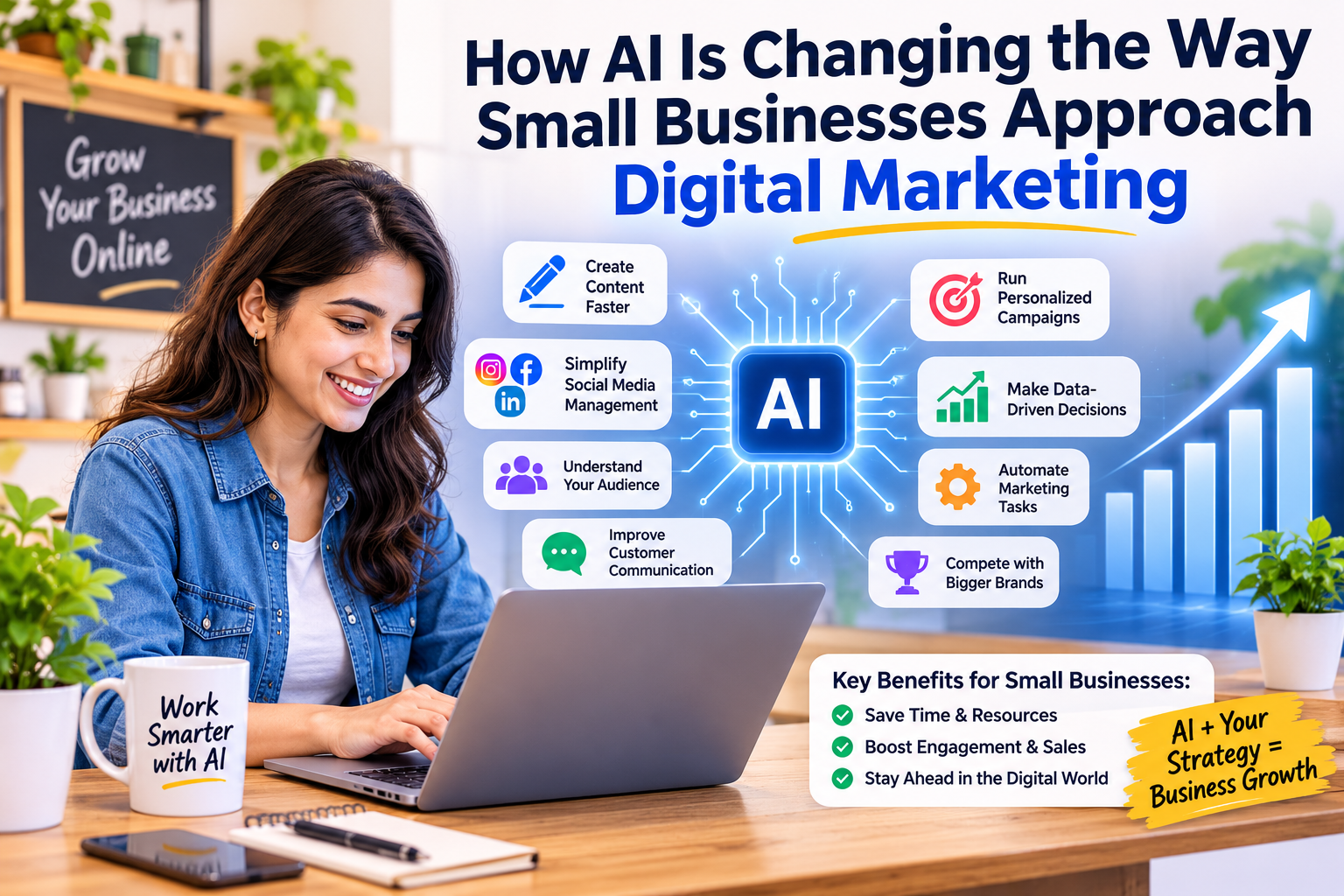
1. Making Content Creation Faster and Easier
Creating fresh and engaging content consistently is one of the biggest challenges for small businesses.
AI-powered content generation tools can help businesses create social media captions, blog outlines, promotional messages, product descriptions, and marketing ideas within minutes.
Instead of starting from scratch, business owners can provide a simple idea or topic and use AI to generate content suggestions.
This allows businesses to:
- Create social media posts more quickly.
- Generate creative captions and headlines.
- Develop blog topics and content ideas.
- Maintain a consistent publishing schedule.
- Spend less time on repetitive writing tasks.
AI doesn’t replace creativity but helps businesses turn their ideas into ready-to-use marketing content.
2. Simplifying Social Media Management
Managing multiple social media platforms can become complicated, especially when businesses need to maintain an active presence on Instagram, Facebook, LinkedIn, and other channels.
AI-powered social media management tools simplify this process by helping businesses plan, create, organize, and schedule their content.
With the right tools, businesses can:
- Generate post ideas using AI.
- Create captions for different platforms.
- Plan content calendars.
- Schedule posts in advance.
- Manage multiple social media accounts.
This makes social media marketing more organized and reduces the need for constant manual involvement.
3. Helping Businesses Understand Their Audience
Understanding customer preferences is essential for successful marketing.
AI can analyze customer interactions, engagement patterns, browsing behavior, and other available data to identify useful trends.
For example, a clothing business may discover that its audience engages more with product demonstrations than promotional images.
Similarly, a restaurant may find that posts featuring special offers receive more engagement during weekends.
These insights help businesses make better marketing decisions instead of relying entirely on guesswork.
4. Enabling Personalized Marketing Campaigns
Customers are more likely to engage with marketing messages that match their interests and preferences.
AI helps businesses personalize their marketing campaigns by analyzing available customer data and identifying different audience segments.
Businesses can use these insights to:
- Recommend relevant products.
- Create targeted promotional messages.
- Personalize email campaigns.
- Develop audience-specific social media content.
- Improve customer engagement.
Personalized marketing helps businesses create more meaningful connections with their customers.
5. Improving Marketing Productivity Through Automation
Small business owners often handle multiple responsibilities at once. Spending hours on repetitive marketing activities can reduce the time available for important business operations.
AI and marketing automation tools help simplify routine tasks.
For example, businesses can automate content scheduling, generate campaign ideas, organize marketing workflows, and prepare recurring reports.
Automation allows business owners to focus more on customer relationships, business development, and overall growth.
6. Making Professional Marketing More Accessible
Previously, creating professional marketing materials often required hiring designers, copywriters, or marketing agencies.
Today, AI-powered tools make several creative tasks more accessible to small businesses.
Business owners can use AI to generate:
- Promotional content.
- Social media captions.
- Marketing campaign ideas.
- Blog content drafts.
- Creative concepts for advertisements.
Although professional review and editing are still important, AI reduces the effort required to get started.
7. Helping Businesses Make Data-Driven Decisions
Successful marketing requires understanding what works and what doesn’t.
AI-powered analytics tools can help businesses interpret marketing performance and identify opportunities for improvement.
Businesses can evaluate metrics such as:
- Social media engagement.
- Website traffic.
- Audience growth.
- Click-through rates.
- Campaign performance.
- Customer interactions.
By understanding these metrics, businesses can refine their strategies, improve future campaigns, and allocate their marketing budgets more effectively.
8. Supporting Better Customer Communication
Customer communication plays an important role in building trust and encouraging repeat business.
AI-powered chatbots and virtual assistants can help businesses answer frequently asked questions, provide basic product information, and guide customers through common queries.
For example, an online store can use a chatbot to answer questions about delivery timelines, return policies, and product availability.
This improves response efficiency and helps customers find information without waiting for manual assistance.
However, complex complaints and sensitive customer interactions should still receive appropriate human attention.
9. Helping Small Businesses Compete with Larger Brands
One of the biggest advantages of AI is that it makes advanced marketing capabilities more accessible.
Small businesses may not have the budget to maintain a dedicated marketing team. However, AI-powered tools can help them perform several marketing activities more efficiently.
From generating content to planning campaigns and analyzing engagement, AI helps smaller businesses improve their marketing processes without necessarily increasing their workforce.
This creates more opportunities for small businesses to establish their brands and compete in the digital marketplace.
10. Bringing Content Planning, Creation, and Scheduling Together
One of the biggest challenges in digital marketing is managing different activities across multiple tools.
A business owner might use one platform for content ideas, another for designing posts, a separate tool for captions, and another for scheduling.
Managing these disconnected workflows can become time-consuming.
Modern AI-powered marketing platforms aim to simplify this process by bringing multiple activities together.
With platforms like Instloo.ai, businesses can simplify their social media workflow by using AI to generate content ideas, create social media posts, and organize their publishing schedules.
Having these activities in one workflow can help businesses save time, maintain consistency, and manage their social media presence more efficiently.
Challenges of Using AI in Digital Marketing
Although AI offers several advantages, businesses should understand that it isn’t a complete replacement for human creativity and marketing expertise.
Some common challenges include:
- Generic content: AI-generated content may lack originality without proper editing.
- Incorrect information: AI-generated responses should be reviewed before publishing.
- Brand consistency: Businesses need to ensure AI-generated content matches their brand voice.
- Over-automation: Excessive automation can make customer interactions feel impersonal.
- Data privacy: Businesses should handle customer information responsibly when using AI tools.
The best approach is to combine AI efficiency with human creativity, experience, and judgment.
Final Thoughts
AI is changing the way small businesses approach digital marketing by making content creation, social media management, customer communication, and marketing automation more accessible.
Businesses no longer need to spend all their time managing repetitive marketing tasks. With the right AI-powered tools and strategies, they can streamline their workflows, understand their audiences better, and maintain a stronger online presence.
However, successful marketing still depends on understanding customers, creating valuable content, and building genuine relationships.
The future of digital marketing isn’t about replacing people with AI. It’s about using AI to work smarter, save time, and make better marketing decisions.
Ready to simplify your social media workflow? Explore how Instloo.ai can help you generate content, plan posts, and manage your social media publishing more efficiently.